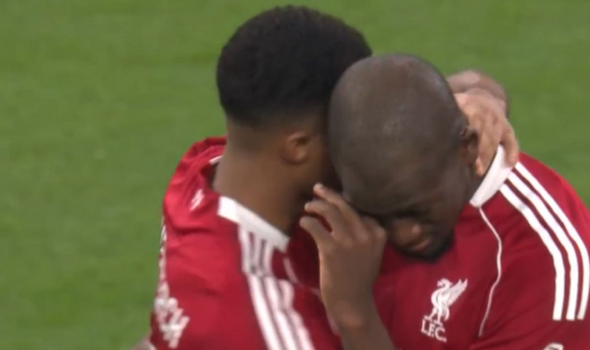
The statement in question—“A Newcastle player said something about my family, and when I reacted, the referee told me to shut up and play”—was attributed to a Liverpool defender in circulating reports and social media posts. The player reportedly added: “I said I would answer them with a goal—and I did. But I am NOT happy. I want an apology or I will take this further. I am a Liverpool player and I deserve respect.” This outburst tied directly into the emotional high of Ibrahima Konaté scoring the fourth goal in stoppage time, his first appearance since the tragic death of his father, Hamady, just days earlier. Konaté had cut short compassionate leave to return and help the injury-hit defense, delivering a standout performance before breaking down in tears during celebrations, embraced by teammates like Hugo Ekitiké (who netted a brace) and Florian Wirtz.
The incident reportedly escalated in the tunnel afterward, with tempers flaring so intensely that security intervened to prevent further confrontation. Players from both sides were said to be furious, turning the atmosphere toxic in moments—amid claims of personal taunts crossing lines during the heated rivalry clash. While no official confirmation from the Premier League, PGMOL, or clubs has detailed the exact exchange or identified the Newcastle player involved, fan discussions and some group posts amplified the narrative, framing it as unacceptable provocation given Konaté’s personal circumstances.
Arne Slot’s reaction to Konaté’s post-match comments and the broader emotion has drawn particular attention. The Liverpool boss, in his press conference, focused overwhelmingly on praise for Konaté’s professionalism and sacrifice—revealing how the defender called him early in the week to insist on returning despite grief, trained twice upon arrival, and produced a “great game” capped by the emotional goal. Slot described it as a “very difficult moment” for Konaté and his family, highlighting the defender’s commitment amid defensive crises (with multiple backline players out). He expressed deep appreciation from the team and fans, who gave Konaté rapturous support throughout. Slot made no direct reference to any referee incident, tunnel drama, or demands for apologies in public statements—instead emphasizing unity, resilience, and the human side of the win. This measured, supportive stance—celebrating Konaté’s tribute to his late father—has been seen by many as a classy response that prioritizes empathy over escalation, though some fans interpret the lack of fiery defense on the alleged abuse as “shocking” restraint or a deliberate avoidance of controversy.
The episode underscores deeper issues: personal boundaries in high-stakes games, the role of referees in de-escalating (or allegedly dismissing) heated moments, and accountability when family is brought into play. Liverpool supporters rallied around Konaté online, hailing his goal as a powerful honor to his father while decrying any perceived disrespect. Neutrals and pundits questioned where the line is drawn in rival banter versus outright abuse, especially in an emotionally charged context.
Ultimately, while the football shone—Liverpool overturning an early deficit with flair and finishing strongly—the off-pitch drama has shifted focus to respect, grief, and leadership. Konaté’s raw emotion and Slot’s heartfelt backing highlight why moments like this transcend results. Football is about more than wins; it’s about humanity, and this night encapsulated both the beauty and the brutality of the game. Whether an apology materializes or further action follows remains to be seen, but the conversation on player welfare and on-pitch conduct is louder than ever.
