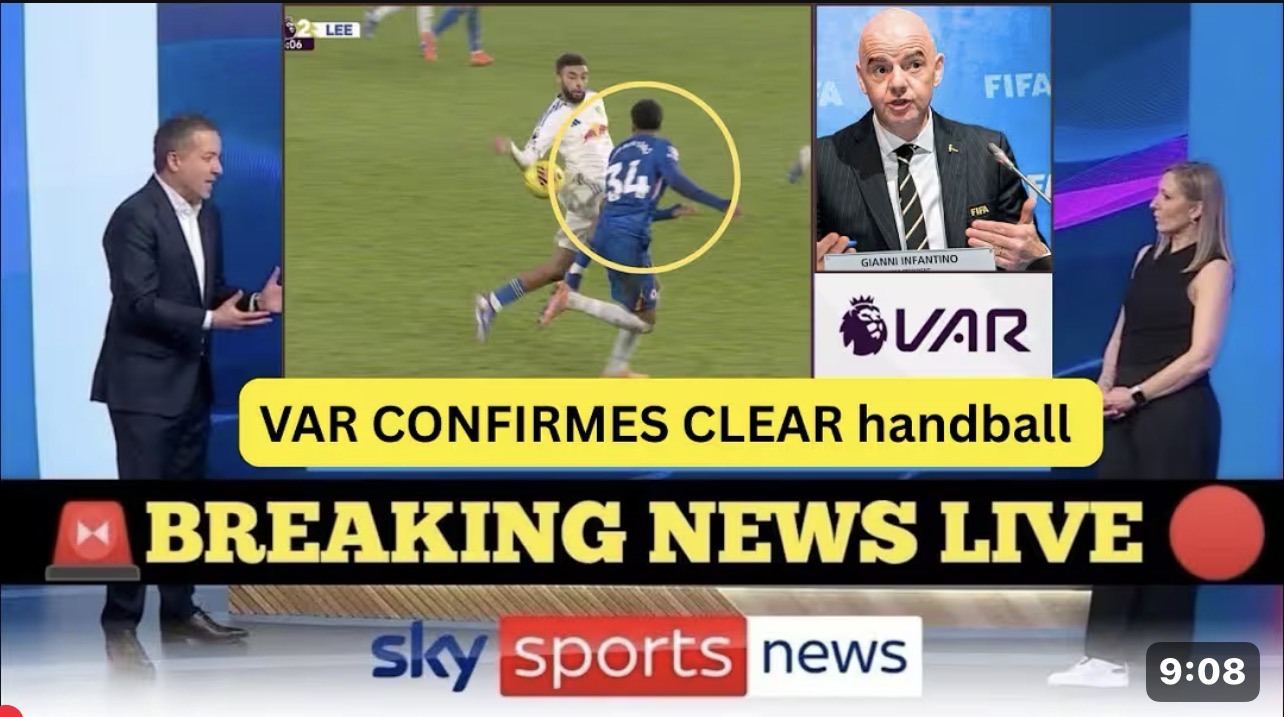
The flashpoint centered on Leeds’ second goal, scored by substitute Noah Okafor in the 73rd minute, which leveled the score after Chelsea had built a commanding 2-0 lead.
Chelsea appeared in control for much of the game under Rosenior’s guidance. They took the lead through Joao Pedro’s opener, followed by a Cole Palmer penalty to make it 2-0. However, the momentum shifted dramatically in the second half. Leeds pulled one back via a penalty converted by Lukas Nmecha after a foul in the box. Then came the contentious equalizer: in a chaotic scramble inside the Chelsea penalty area, the ball struck Leeds defender Jayden Bogle’s arm/elbow during the build-up before Okafor pounced on poor defending to slot home into an empty net.
Replays clearly showed the ball making contact with Bogle’s arm, leading to immediate protests from Chelsea players and staff. Many viewed it as a blatant handball that should have resulted in a free-kick and the goal being disallowed. The on-field referee, Robert Jones, allowed the goal to stand, and VAR reviewed and confirmed the decision. The Premier League’s official Match Centre posted on X (formerly Twitter): “The referee’s call of goal to Leeds United was checked and confirmed by VAR – with there deemed to be no handball offence by Bogle in the build-up.”
This explanation cited that it was not deemed a punishable handball offence—likely due to interpretations around whether the arm position was unnatural, the contact deliberate, or if it met the criteria for offence under current laws (which distinguish between deliberate actions and accidental ones in certain contexts, though handball rules in the build-up to goals have been a point of contention). Former referee Mike Dean expressed surprise on Sky Sports commentary, stating he was shocked it wasn’t disallowed. Ex-PGMOL boss Keith Hackett defended the call in some outlets, calling it an “accidental handball” that VAR correctly allowed.
Chelsea manager Liam Rosenior was visibly furious in his post-match interview, describing the decision as “unacceptable.” He argued that any handball contact in the lead-up to a goal should disallow it, regardless of intent: “The rule is if there’s any contact with his hand it should be disallowed… The lad [Bogle] handballs it. He handballs it, it affects my players in that moment, they think it’s a handball, we switch off, we don’t clear the ball, they score.” Rosenior added that the incident “got me angrier” when clarified that VAR ruled it non-deliberate, insisting the rules demand stricter application here. He claimed the non-call directly impacted his team’s focus and contributed to conceding the equalizer.
Chelsea fans exploded with anger online and in post-match reactions, flooding social media with accusations that VAR “robbed” them again. Posts labeled it a “clear handball,” “illegal goal,” and evidence of inconsistent officiating favoring certain teams. Some called it one of the “worst defending you’ll ever see” combined with refereeing blunders, while others pointed to broader frustrations with VAR’s reliability in the Premier League. YouTube channels and fan accounts amplified the outrage with titles like “VAR ADMITS BLUNDER AS CLEAR HANDBALL GOES UNPUNISHED” or “CHELSEA ROBBED AGAIN,” though official sources show no formal admission of error from VAR or the Premier League—rather, they upheld the on-field call. Some sensational headlines appear to exaggerate by claiming VAR “admitted a mistake,” but the core statement remains that no offence was deemed.
The draw cost Chelsea valuable points in what could be a tight race for top-four or European qualification spots, especially given their strong first-half performance. Leeds, fighting in their own battle (perhaps for survival or mid-table security), celebrated a hard-earned comeback that highlighted their resilience but was overshadowed by the controversy.
This incident reignites ongoing debates about VAR in English football: its consistency, the subjective nature of handball interpretations (unnatural position vs. deliberate, direct impact on play), and calls for clearer rules or even post-match reviews/admissions when errors occur. Similar controversies have plagued matches in recent seasons, eroding trust among fans, players, and managers. For now, the result stands as Chelsea 2-2 Leeds United, but the handball debate—and the outrage it provoked—will likely linger, fueling discussions ahead of any potential PGMOL clarifications or future tweaks to officiating protocols.
