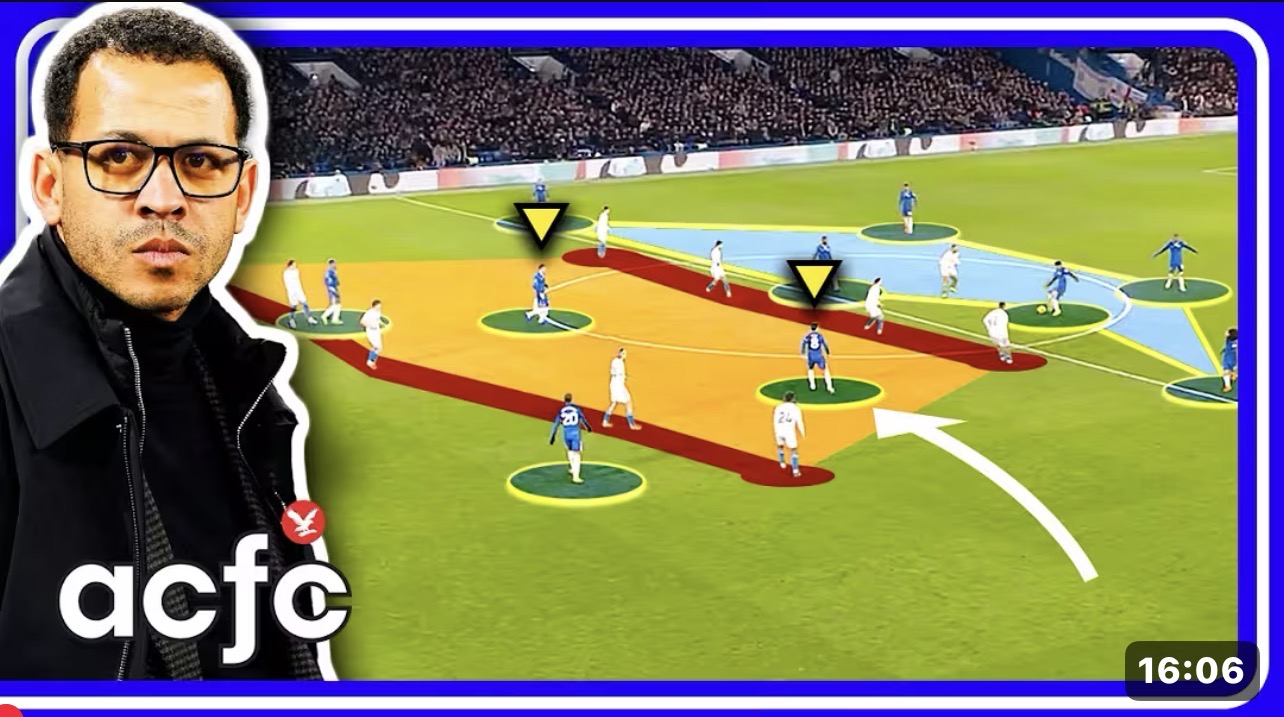
While many expected a continuation of Enzo Maresca’s possession-heavy, inverted full-back philosophy, Rosenior has introduced a subtle but transformative tweak: a more balanced, dynamic midfield setup built around a double pivot featuring Andrey Santos and Moisés Caicedo, freeing Enzo Fernández to operate as a true No.10 and unlocking Cole Palmer’s full potential in advanced areas.
Under Maresca, Chelsea’s midfield often felt congested or unbalanced — Fernández and Caicedo sharing deep responsibilities, with Santos mostly on the periphery or pushed higher in limited cameos. Rosenior, drawing from his successful time at Strasbourg where he worked closely with Santos, flipped the script. The Brazilian youngster now anchors the base alongside Caicedo in a compact double pivot, providing defensive steel, intelligent ball progression, and relentless energy. This allows Fernández to drift into the half-spaces or No.10 role, where his vision, passing range, and goal threat shine brightest.
The results have been immediate and eye-catching. Chelsea’s midfield now controls games with greater poise: fewer turnovers in dangerous zones, quicker transitions forward, and a noticeable uptick in attacking fluidity. Santos’ emergence as a “linchpin” — winning duels, breaking lines with progressive passes, and covering ground tirelessly — has been hailed by pundits as the key cog. Paul Merson recently noted that Santos’ form is so strong that Rosenior won’t revert to playing Palmer centrally as a No.10, even though that’s arguably the Englishman’s best spot. Instead, Palmer thrives on the right wing or in roaming roles, interchanging with Fernández and wingers like Pedro Neto, creating overloads and unpredictability in the final third.
This isn’t a complete overhaul — Rosenior has kept elements of Maresca’s build-up play, with short, sharp passing from the back and occasional full-back involvement — but the genius lies in the pragmatism and adaptation. He pushes wingers higher and wider for better width, encourages more direct forward play when opportunities arise, and dials up pressing intensity without overcommitting. In-possession, the team often morphs into a 3-2-5 or fluid 4-3-3/4-2-3-1 hybrid, packing central areas with interchangeable bodies while maintaining defensive solidity.
Fans and analysts point to this midfield recalibration as the reason Chelsea look calmer, more electric, and better at protecting leads. The side has surged in form since Rosenior took over, with improved results against top opposition and a collective mentality that’s evident in comebacks and high-pressing displays. Rosenior himself has emphasized adapting to his group rather than imposing rigid ideas — a refreshing contrast to more dogmatic approaches — and it’s paying dividends.
The ripple effects are huge: Santos, once underutilized, is now indispensable at 21, with his market value soaring. Fernández regains his creative freedom without sacrificing defensive duties entirely. Palmer’s output rebounds as he exploits spaces created by the balanced engine room. Even full-backs like Reece James (when fit) benefit from less inversion pressure, allowing more traditional overlaps.
In a league where tactical flexibility often separates contenders from pretenders, Rosenior’s masterstroke has been recognizing the squad’s strengths and reshaping the midfield to maximize them. No grand reinvention — just smart, player-centric evolution that has Chelsea playing with purpose, balance, and flair. If this continues, the Blues could be serious players in the title race and beyond.
The Premier League is taking notice: what started as a cautious appointment is quickly becoming a tactical revelation.
